
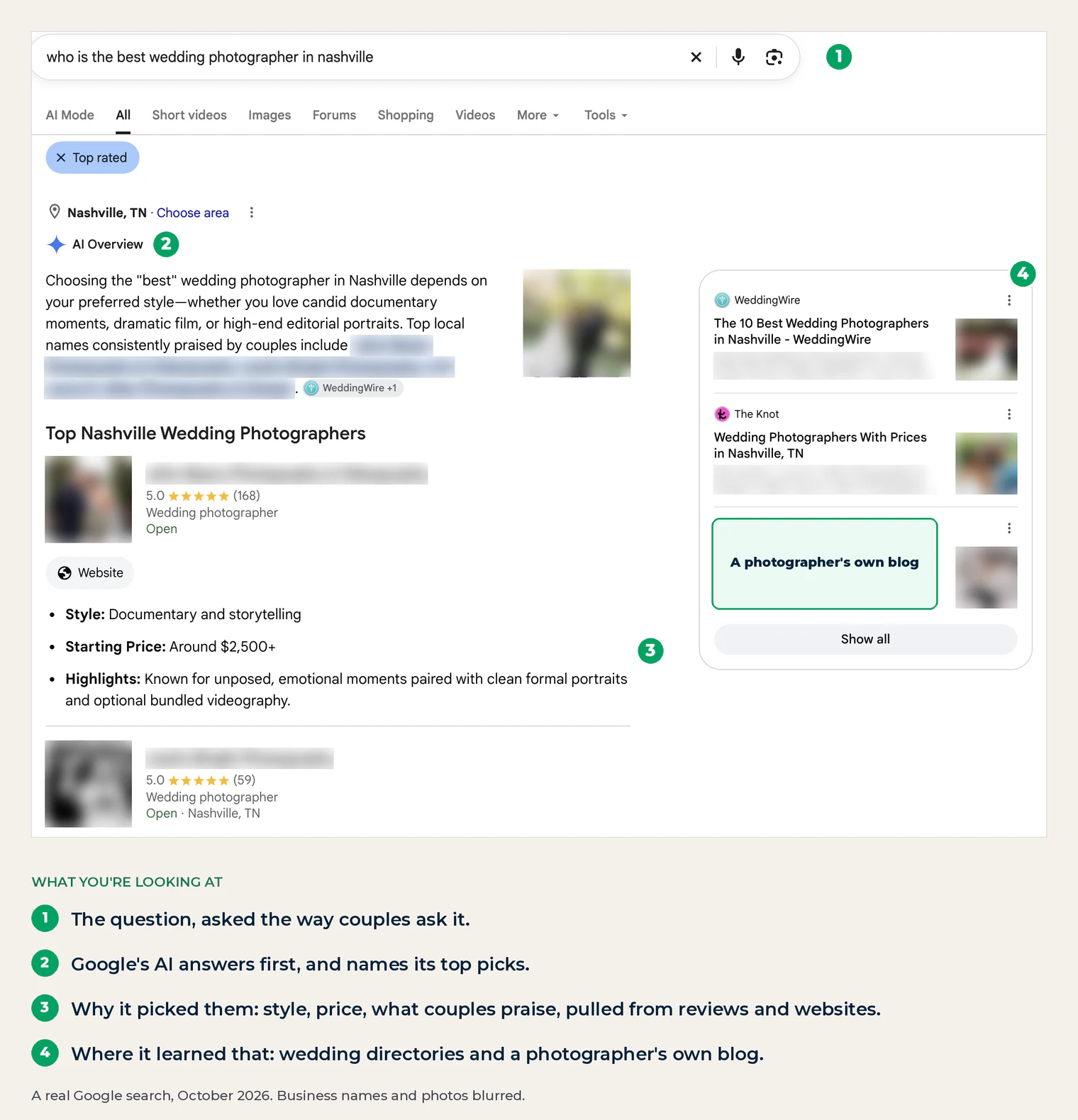
For years, the Google game was simple, if not easy: show up in the search results and couples would find you. That game has changed. Search for a wedding vendor on Google now and, more often than not, the first thing you see isn't a list of businesses. It's an answer written by Google's AI, naming a few vendors and telling the couple why. The search results you worked so hard to rank in sit underneath it.
So when I talk with wedding pros, one question comes up again and again: what do I need to do to get found in AI search?
Here's the short answer: you don't need a whole new playbook. Google's AI answers are built from the same things Google has always looked at. The difference is that AI grades harder, and it names a few businesses instead of a page of them.
What actually changed
Whitespark, a company that studies local search, found Google's AI answers (it calls them AI Overviews) on about 68% of local searches. And ranking well isn't the guarantee it used to be. One study they cite found that a business in Google's top 10 results had only about a 25% chance of showing up in the AI answer.
Here's why that matters. Google isn't just listing results anymore. It's answering the couple's question directly, and the businesses it quotes in that answer are the ones getting the clicks. Seer Interactive studied 53 brands and more than 5 million searches. When Google showed an AI answer, businesses quoted in it got about twice the clicks (120% more) of businesses that weren't. Being in that answer is gold.
Google has also added AI Mode, a tab right in Google search. Instead of a list of links, Google's AI writes out the answer, and the couple can keep asking follow-up questions. Two couples asking the same thing may not even see the same vendors.
And it isn't only Google. BrightLocal's 2026 survey found that 45% of consumers have used ChatGPT or another AI tool to find local businesses, up from 6% the year before. Gemini, Perplexity and Microsoft Copilot do the same thing. They each work a little differently, but they lean on the same signals, so everything below applies across the board.
And couples search differently when they're talking to AI. They don't just type "wedding photographer Nashville." They ask a real question, like Who's the best wedding photographer in Nashville?, and the AI answers with a handful of names and a reason for each.
A handful of names. That's the whole shelf. The question is whether you're on it.
What AI looks at before it names you
AI search is built on the same foundations as Google. It just rewards the businesses that keep them up. Here's what it looks at:
1. Your Google Business Profile. This is the free listing that shows your business on Google and Google Maps, and it's where Google's AI gets your star rating, your review count, your hours and your photos. It needs to be claimed, complete and accurate, with the right categories and service area. And it needs to be active. Posting to it regularly tells Google you're open, busy and current. Most vendors set theirs up once and never post again.
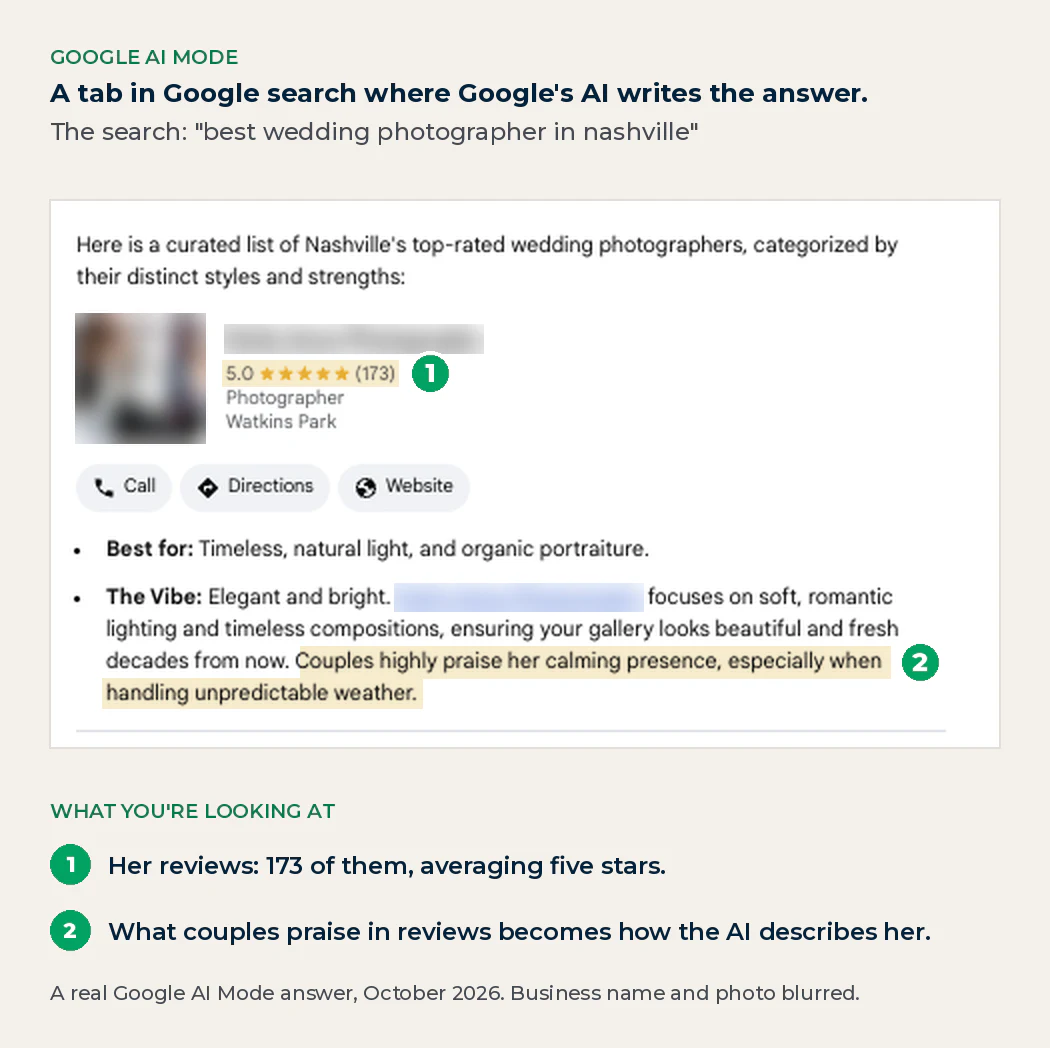
2. Reviews, and recent ones. AI tools lean heavily on reviews to decide who to recommend and what to say about them. Look at the example below from Google's AI Mode. That 5.0 rating and those 173 reviews come straight from her Google Business Profile. And the line about her calming presence? That's Google's AI summing up what her couples wrote. Couples pay attention to recency too: BrightLocal found 74% of consumers only pay attention to reviews from the last three months. If your best review is from 2023, it's not doing much work.
3. Your replies to reviews. 89% of consumers expect businesses to respond, and half are put off by generic, copy-paste responses. A real reply in your own voice tells couples (and AI) that a real person runs this business.
4. Your own website, with real detail. AI matches couples to vendors based on specifics: the venue, the town, the season, the style, the kind of couple you work with. A gallery with no words gives it nothing to go on. A blog post about a real wedding at a real venue gives it everything. When I searched "who is the best wedding photographer in Nashville," one of the three sources Google pointed to, in addition to WeddingWire and The Knot, was a photographer's own blog.
5. Being mentioned in other places. Other vendors' blogs, publications, directories, preferred-vendor lists. When your name shows up consistently in places AI trusts, it gets more confident recommending you. Make sure your business name, address and phone number match everywhere.
Why this favors real wedding pros
AI is looking for proof. And you have more proof than almost any other kind of business.
Every wedding you work is a story with names in it: the venue, the town, the planner, the florist, the time of year, what made that couple different. That's exactly the kind of specific, current detail AI uses to decide who fits a couple's question.
Most vendors let that proof sit in a gallery folder. The ones who get named are the ones who write it down, post it and keep it going.
What showing up looks like
The vendors who show up in AI answers aren't doing anything magical. Their Google profile is complete and current. New reviews keep arriving, and every one gets a real reply. Their real weddings are written up on their own website, with the venue, the town and the team named. And it keeps going, month after month, because AI favors businesses that are clearly active right now.
If you're curious where you stand, search your own category in your own town and see who Google's AI answer names. That's the shelf.
How The Wedding CMO helps
This is exactly why we built The Wedding CMO.
None of this is hard. It just takes consistency, and that's tough on top of the actual weddings. So we built a tool that does it for you. Upload a wedding, talk through it, and The Wedding CMO turns it into a blog post, a post for your Google Business Profile, Pinterest pins and social posts, all in your voice, with your fellow vendors credited. Every time you add a wedding, you get a new post ready for your Google Business Profile. Keep adding weddings, and your profile never goes quiet.
It also writes a review request for the couple, in your voice, with a link that takes them straight to your Google Business Profile to leave it while the day is still on their minds. You approve everything before it goes anywhere.
One wedding in, a whole set of marketing out. Every wedding you add keeps it going, so you're consistently putting out the specific, real, current proof that gets you found on Google and named by AI, without any of it becoming your homework.
The part AI can't do
AI can't shoot your weddings, design your florals or calm a bride down when the cake is late. What it can do is take your weddings, your photos and your stories and turn them into the kind of content that gets you found on Google and in AI search.
Sources
BrightLocal, Local Consumer Review Survey 2026 (Feb 2026)
Whitespark, Guide to Google's AI Mode for Local Businesses (May 2026)
Seer Interactive, AIO Impact on Google CTR: 2026 Update (Apr 2026)